Lynn Amber - Travel & Photography
sharing my thoughts through words and images
First Snowshoe
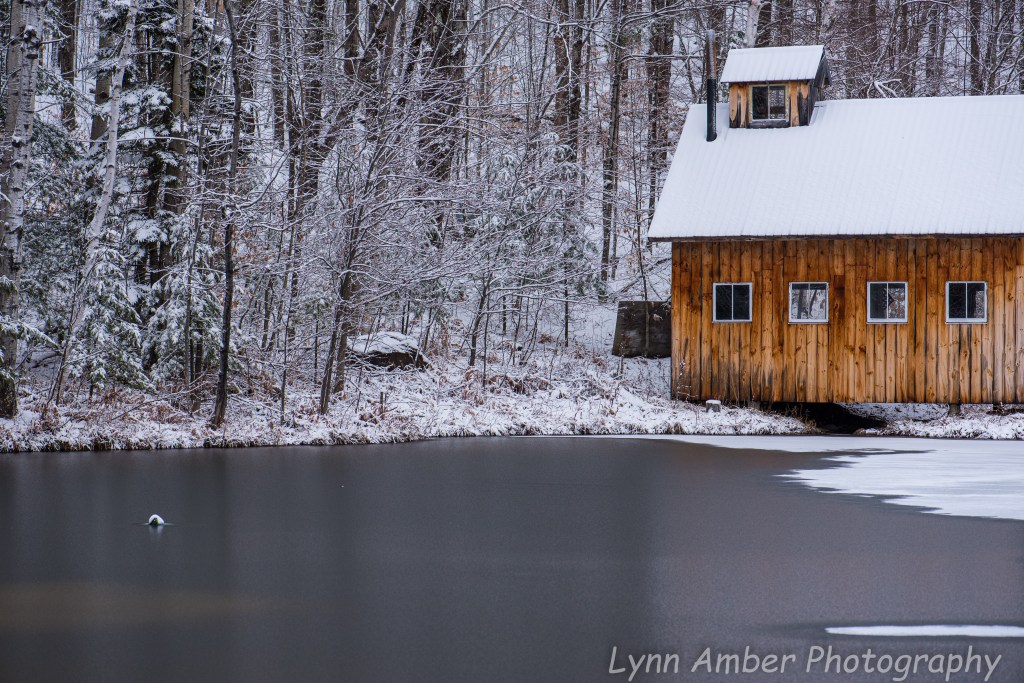
Our first snow of the season was really little more than a dusting. It was heavy and clung to the tree branches – as evident in the photograph above.
Our second snowstorm was much more promising! It was bitter cold and so created a nice, fluffy layering of snow. It was significant enough in depth – about 10″ – to guarantee that it would qualify as a “snowshoe” snow. It’s always exciting to pull out the snowshoes for the first time each winter and head into the woods.

I’m very fortunate that our 10-acre property is surrounded by neighbors who have larger tracts of forested land. For over 20 years, I’ve had permission to snowshoe through their woods. It’s so rewarding to be able to just head out my back door adorned with snowshoes and walk for hours. I have to be patient and wait for hunting season to end, but once mid-December arrives, I’m good to go with no fear of disturbing anyone.
For many years, my faithful border-collie/black lab dog, Lucy, accompanied me on these snowy treks through the woods. I had developed a fairly consistent route that I would reestablish at the start of each season. I used existing logging roads or 4-wheeler hunting trails developed by the landowners, with occasional connecting paths made by me between the properties or established trails. These “connector” trails were identified by me each year through landmarks in the woods – an ancient, gnarly maple tree marked one turn while a giant, multi-trunked pine growing next to an opening in a stonewall guided me on to the next landmark – and so it went. At times, I would have trouble picking up my path from the previous year during the initial trail-setting. There were always changes in the forest from the previous year – either naturally-occurring or man-made – that would alter how I remembered a particular spot.
This is where Lucy came to the rescue. She had an uncanny ability to “pick up” our route from year to year. I remember at times standing in the snow, scanning the landscape around me, desperately trying to find the correct direction to the next landmark. All I had to do was say “Lucy – which way?” and off she would go in front of me – guiding me almost precisely through a thicket or pine stand in exactly the same place as the previous year! She loved to run ahead of me following scents and sounds, but she never failed to circle back and check on me – making sure I was okay.

Yesterday, we started snowshoeing with the temperature hovering around 14 degrees. The air was still and the skies were bright and blue. Perfect conditions!! 🙂 I always start my trek by heading back past our sugarhouse and up into our woods. Once I cross over the stone wall that marks our boundary, I bushwhack my way up through a scotch pine stand and pick up my neighbors logging trail. From there, I weave my way through the acres and acres of woodland – zig-zagging between both my neighbors properties. The quiet is almost deafening! 🙂 It was a glorious day on the trail!

Another Vermont Sunrise

I was focused on reading the annual Holiday email letter from a fellow Vermonter and blogger this morning – all while enjoying my morning coffee in “my favorite recliner.” When I finished reading the letter and admiring the photos that were included, I glanced up and was just in time to witness this absolutely incredible sunrise.
I had just enough time to grab my camera, slide on my slippers and head out to the front porch for a shot. Unbelievable colors!
Snowy Day

My husband and I took a hike back in the woods this morning in search of a potential Christmas tree. We did not really find one suitable enough – not surprising really – but we gave it a good try! Our first snowstorm of the season dumped little more than an inch on the ground. Disappointing….the effect was nice though and the snow was clinging to the tree branches creating a “winter wonderland” look.
Baltic Mill in Enfield
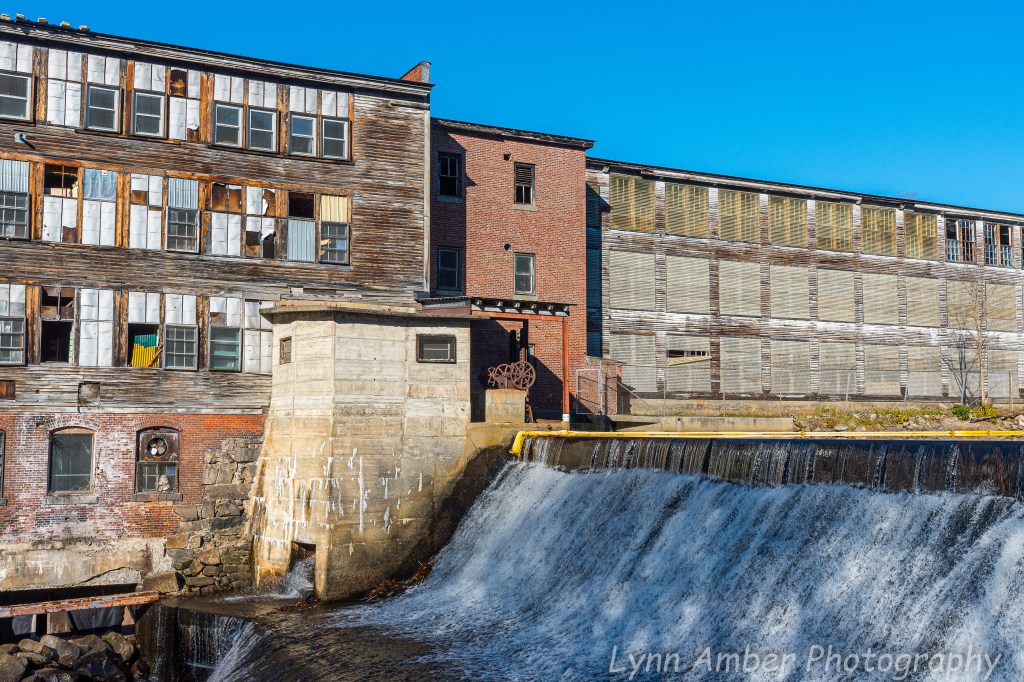
This writing is a follow-up to an earlier post I composed about the Northern Rail Trail. I included another photo of this building on that post with a notation that I would do some more research and find out what it’s function was when operational.
I was correct in my original guess that this was a textile mill. This building was called the Baltic Mills. Originally established in 1886, it went through several ownerships. The last owner to operate the mill was the American Woolen Company. According to a book that details the history of the mills owned by the American Woolen Company, the chief products were “principally men’s overcoating stock, and friezes, chinchillas, and cheviots.” In addition, the mill generated its own electricity and also helped to power part of the town! The book states that the company “in addition to lighting its mills, furnishes light for the streets of the town and for use in dwellings and stores, from its 6oo-light alternating dynamos.” Cool! The operation also supported over three hundred mill workers at the time.
For additional reading on the history of the mills owned by American Woolen Company, here is a link to the Google book.
Beaver Moon
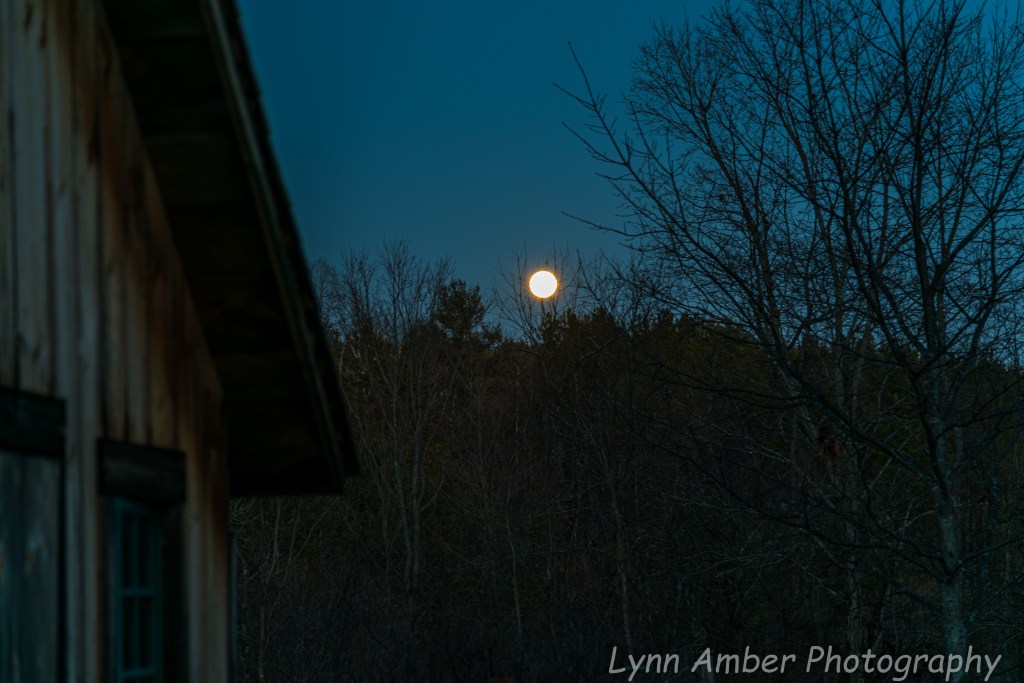
The November full moon is often referred to as the Beaver moon as it was observed that beavers were most active during this time of the year preparing their lodges for the long winter ahead. The moon has appeared full for several nights now. We took a walk up the road last evening as the moon was rising and it was magical the way it was shining through the forest – casting long tree trunk shadows across the landscape.
I caught the full moon coming up tonight framed by our garden shed and the oak tree in the front yard. If you have the energy to get up early, there will be a lunar eclipse happening at around 4:30 am Monday morning! The eclipse will begin around 2:30 and end around 6:30 – from what I’ve read.
Old Factory

We are having a quiet Thanksgiving holiday as we do our part to help suppress the spread of the Covid-19 virus. We would normally get together with family here in Vermont. But this season, our extended family is celebrating in their own households, as we are. We do have just one guest – my son who is visiting on his own from our neighboring state of NH. We’ll just be hanging out here at home and it has been a nice time catching up with him. I am grateful to have this time with him.
Our topics of conversation vary – covering everything from politics to recent home projects – often revolving around what we have been doing recently for fun. In talking to him about a recent bike trip on the Northern Rail Trail, my husband was mentioning this old factory that sits along the bike trail. We had stopped along the trail to admire the old crumbling architecture of the building and survey the dam that obviously was used to generate power for whatever operation took place here. As an engineer whose specialty is “power”, my son is always interested in these old technologies.
I looked through my photo files and found the picture I took of the building and dam – so I could give my son a “visual” of the place. What an interesting collage of colors and textures! At some point, I will follow up researching what this building was – a textile mill, perhaps?
Artists in the Parks
I received a couple of comments about my previous post highlighting the carved log which honors the nature poet Seamus Heaney. My own curiosity about how these logs came to be transplanted into the Marsh-Billings-Rockefeller National Historic Park landscape led me to do some “Google” research. 🙂
Throughout the national park service, there is a quiet movement underway that brings art, artists and our national parks together. The result is a robust Artist-in-Residence program that exists in many of our national parks nationwide. Most people visiting our national parks are totally unaware of these collaborations or the impact they have on both the park and the public. I became aware of this marriage between artists and parks during my two-year tenure at Acadia National Park as a park ranger. Through staff email alerts and exploring our park website, I familiarized myself with the artist-in-residence program there and learned about current and past projects.
During my second season at Acadia, I had the opportunity to participate in a night photography workshop led by the local Mount Desert Island artist and photographer, Howie Motenko. During the course of the evening workshop, he shared his most recent enterprise with us. He had just completed a 2-year photographic study within Acadia National Park. Over a 24 month period of time, he photographed landscape scenes in Acadia National Park using the light of the full moon. At the conclusion of our evening workshop, he shared his best large format prints with us. An exhibition of these photographs would be held during the month of November (2019) at the Northeast Harbor Library. The prints were stunning. Howie Motenko had been a former artist-in-residence in Acadia. I left Mount Desert Island at the end of October so I did not get to see the exhibit. But, I appreciated that he had given us a sneak preview!
In wondering about the carved poetry logs throughout Marsh-Billings-Rockefeller National Park, it had not occurred to me that these pieces represented the work of an artist-in-residence. I should have probably suspected that given my experience in Acadia! Well, it turns out that there is an artist-in-residence program at Marsh-Billings-Rockefeller NHP. The carved poetry logs are the work of New York-based environmental artist Alastair Noble . He was an artist-in-residence at the park during 2013-2014. According to the Park Facebook page: “Each log was carved by Noble with a line from poems highlighting the wonders of nature. Some are from poets like T.S. Eliot, Seamus Heaney, and Edgar Allen Poe. These logs were scattered throughout the park with the idea that visitors will “discover” them when they least expect it. As of 2020, the logs are more difficult to read as they are slowly decomposing, just as Noble intended.” Apparently there are at least 10 logs in existence. I cannot wait to get back there and find the remaining 8 poetry logs!! 🙂
So, before you head out to your next national park – do some research and find out if they support an artist-in-residence program! The National Park Service has an overview of the program here. To learn more about the program at Marsh-Billings-Rockefeller NHP, visit their Artist in Residence home page. You just never know what you might discover!
Poetry in Nature

During our last hike at Marsh-Billings- Rockefeller National Historic Park, I came upon another interesting wood carving along the shores of The Pogue. Someone here at the park is obviously a fan of the Irish poet Seamus Heaney! This line is taken from his poem “Relic of Memory.” It is so much fun to find these “relics” hidden in the woods along the carriage paths. I wonder if there are any more? Guess I’ll have to go back and explore so more!
Yet Another stunning sunset

We’ve been experienced some remarkable sunsets recently. Heading up my gravel road after work today, the sun was just starting to dip below the horizon. As I’ve said before, this is one of my favorite times to be out walking – so peaceful and still. A great way to start the weekend! 🙂
Vermont’s Stone Walls
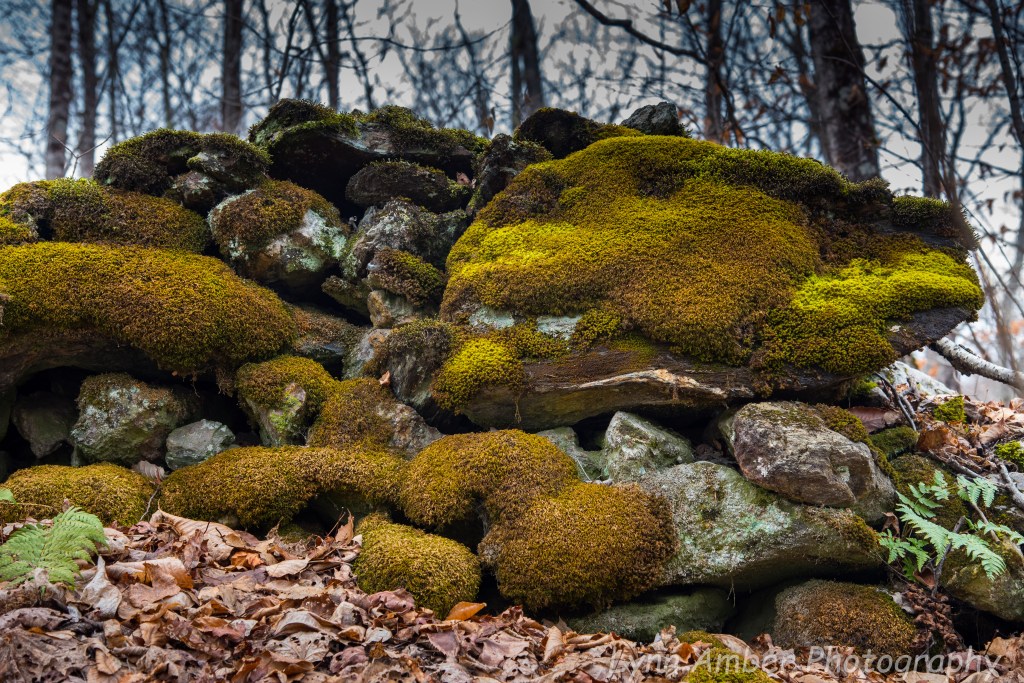
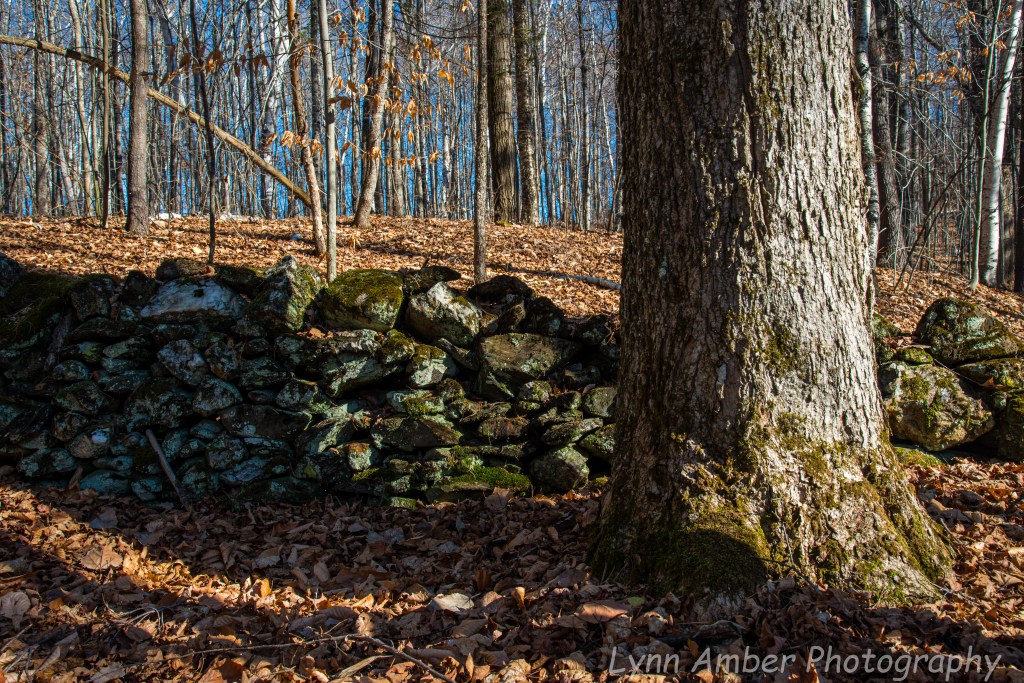
Walking the backroads, hillsides and forests of Vermont, it is inevitable that you will have an encounter with a stone wall! I’ve heard estimates claiming there are over 200,000 miles of stone walls in New England. Many of these stone fences were built in the 1800’s during a time when “sheep fever” was taking hold in the northeast. With tariffs being levied on woolen goods from England at that time, people began raising sheep so we could produce our own wool.
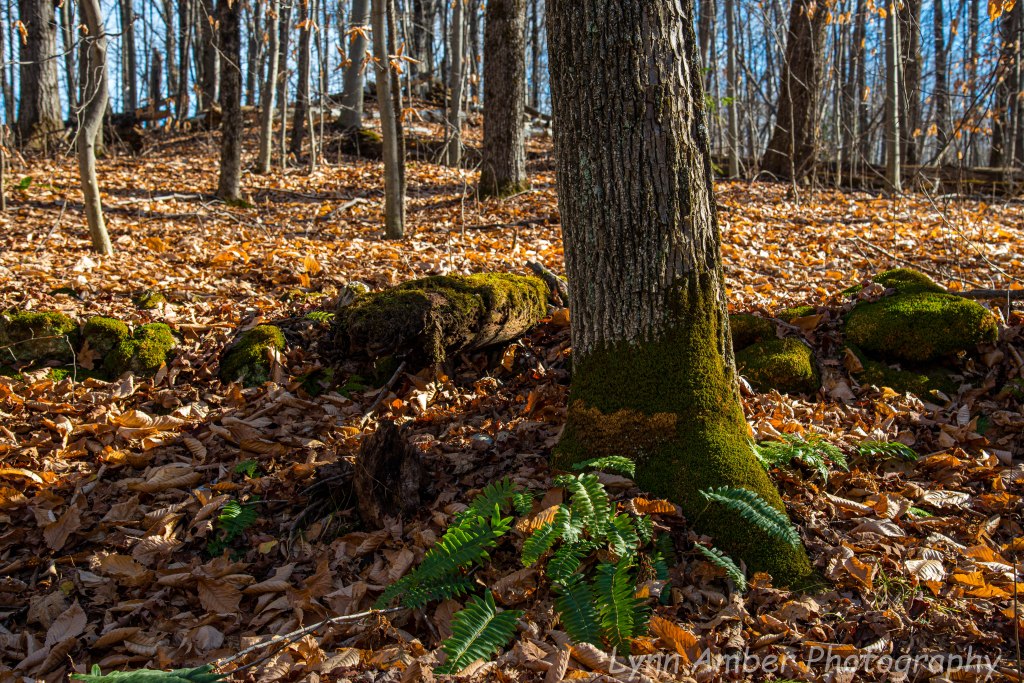
Much of Vermont’s forests were cut down during the 1800’s for agricultural endeavors including clearing land for grazing sheep. An abundance of stone led to the use of this material as fencing for containment of the sheep and other agricultural animals. Between 1824 and 1840, Vermont’s sheep population grew from 4,000 head to over 1.5 million. That’s incredible! By the 1850’s, however, things began to change. The tariff’s were lifted driving down the price of wool and competition was growing from the western states. It was a boom industry here for only several decades. But, in its wake, we are left with miles and miles of beautiful, old stone walls! In later years, the stone walls were often used as boundary markers when land was subdivided. One of our property lines is defined by an ancient stone wall.
If you are interested in additional information on the history of the sheep industry of yesteryear, the Vermont Historical Society has an online pamphlet that might interest you. It really is a fascinating story about how early Vermont settlers literally deforested the land and it’s subsequent “comeback” to the Green Mountain state of today. I also stumbled upon this charming article – Sheep Farming – Then + Now – in a modern day blog site that might interest anyone who fancies learning more about the 14th State.
Another really good reference book is the natural history story “Reading the Forested Landscape”, by Tom Wessels. This book sits on my nightstand – and I often just pick it up and read small snippets at a time – about the fascinating art of “reading the landscape.”
 Lynn Amber - Travel & Photography